From February through May the airport fills with bike boxes and the bay roads are busy by seven. Here's how a real training week looks. Two bases, six rides, split between Playa de Muro in the north and Palma in the southwest, with the full Tramuntana menu in between.
"Ride as much or as little, as long or as short as you feel. But ride."
Eddy MerckxMallorca is where most of Europe's cyclists end up in spring. Most people pick one hotel and ride from it for a week. That's the mistake. Half the best roads are too far to reach as day rides. A real training week splits between two bases.
Palma de Mallorca's airport is twenty minutes from the centre of Palma and about an hour from the northern coast at Alcúdia. From the UK, Germany, or the Nordics you're looking at two-and-a-half to three hours in the air. If you're flying with a bike box, book the rental car or transfer in advance. Ride-sharing apps don't take bike bags reliably.
Most cyclists hire a car for the week. It's the simplest way to ferry a bike box plus luggage, and it gives you the pivot from base one to base two on day four without choreography. If you're flying light and renting on the island, the bus from the airport runs hourly to both Palma and Alcúdia for a few euros each.
The Tramuntana spine is what makes Mallorca great and what makes one base insufficient. From the north, your first climbs are Coll de Femenia, Coll de sa Batalla, and the spin to Cap de Formentor. From the southwest, the same range looks different, climbing in from below through Valldemossa, Estellencs, Banyalbufar, and the famous switchback to Sa Calobra.

Playa de Muro, the cycling-camp heartland
The northern bay of Alcúdia is where most of Mallorca's bike marketing traces back to: properties that have been hosting groups for fifteen years, with secure storage, mechanics on site, breakfast at six, and group rides leaving at seven-fifteen.
Sits on the long sandy beach south of Alcúdia town. The quieter, more boutique-feeling option: fewer big tour groups, calmer dining rooms, the same one-minute roll-out to the coast road.
See the bike-score breakdown on RideLodge →The bigger, more established cycling-camp brand: organised rides, the largest workshop on this side of the island, and a buzz of riders that some love and others find too loud at breakfast.
See the bike-score breakdown on RideLodge →Find more bike-friendly hotels in Mallorca →
The first day of any camp is the leg-loosener. From Playa de Muro you roll south through the shallow farmland behind the bay (flat tarmac, the smell of orange groves, traffic that hasn't woken up) and loop back through Sa Pobla and Muro.
Fifty kilometres, eighty minutes of riding, no climbs to speak of. The point is to remember what your bike feels like after the flight and to get the chain quiet before tomorrow.

Eighty kilometres, the climb to Mirador de la Creueta, the lighthouse at the tip, the photo every cyclist takes against the rocks. The road climbs in three steps, none of them steep, and the wind on the descent, depending on direction, either gives you free time or fights you the whole way back.
Stop in Pollença on the return for an espresso under the plane trees in the square.

Watch the wind. The Formentor descent either gives you free time or fights you the whole way back. Check the forecast before rolling out, and don't burn matches into a headwind on the climb if you'll be paying for them all the way home.
The first proper climbing day. Up Coll de Femenia out of Pollença, along the ridge to Lluc (the monastery at 525 metres where almost every long Mallorca ride passes through), and back down.
A hundred and ten kilometres, fifteen hundred metres of climbing. By the time you're spinning home along the bay road, the legs are open. You've done the build.

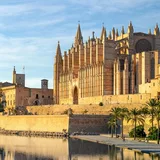
Palma one week, the north the next. The base matters.
A short coastal spin in the morning, thirty kilometres of pressure-free pedalling, then the drive south. Palma is ninety minutes from Alcúdia by road, and you'll arrive with time for an unhurried lunch and an afternoon nap before the second half of camp begins.
The mistake is making this an off day entirely; the better plan is a short opener and an early bed.

Don't skip the morning ride. Three days in, the legs need rotation, not rest. A complete off-day going into Day 5 makes the first climb out of Palma feel harder than it should. A thirty-kilometre flat spin keeps the system primed.
Palma, the city base
Palma is a city, and that changes the camp's tone. Tapas in the evening, local cafés that aren't built around cyclists, the cathedral lit up against the bay at night. The riding from here climbs into the Tramuntana from the south: different roads, different angles, the same range you've been looking at all week.
In Can Pastilla, just east of the airport. The practical, no-fuss option: secure bike room, easy roll-out west toward the climbs, ten minutes to the city centre when you want it.
See the bike-score breakdown on RideLodge →Central Palma, closer to the cathedral and the old town, with a wellness floor that earns its place after the queen stage of day six.
See the bike-score breakdown on RideLodge →Find more bike-friendly hotels in Mallorca →
Out of Palma along the coast road, the climbs to Estellencs and Banyalbufar stacking up against the sea, the road threading between cliffs and water, the kind of corner you slow down for not because of the gradient but because of the view.
Eighty-five kilometres, twelve hundred metres of climbing. The cafés in Estellencs are some of the best on the island: small, run by locals, the coffee comes in a glass.

Sa Calobra is the climb that makes Mallorca's reputation: nine and a half kilometres of relentless seven-percent ramps from the cove back up to the main road, with twelve hairpins that turn back on themselves and the famous Nus de Sa Corbata (the "tie knot"), where the road loops fully under itself. There is only one road in, and the only way out is to climb.
Combined with Puig Major approached via the Sóller tunnel, you get a 130-kilometre ride with twenty-five hundred metres of climbing. Pace Sa Calobra like a sustained threshold effort. The second half is steeper than the first, and the only riders who break it are the ones who tried to race the bottom.

Eat on the way down, not on the way up. Once you reach the cove at the bottom of Sa Calobra, there is nothing to do but climb back out. Riders who arrive at the bottom hungry pay for it in the first three switchbacks.
Two bidons minimum. The summit café at Puig Major is the last reliable refill. Top up before the descent to the cove.
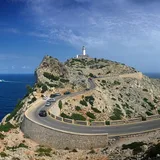
Two bases this week. Sort both before you book flights.
The recovery day is short, social, and ends at a café. A flat thirty-kilometre spin out of Palma along the bay road, coffee at one of the cycling-friendly stops in Portixol, then back.
After lunch, the beach. The cathedral at sunset. A meal that doesn't end with espresso on the bike.


Stronger
than you came
There's a particular feeling on day seven, packing the bike box on the hotel terrace, when the legs are different from the legs that arrived. Stronger, lighter when you stand on the pedals, slower to climb but quicker to recover. Mallorca packs the architecture of a real training camp into seven days and two bases, and the week leaves you measurably fitter without ever feeling like work.
You came to ride a famous island. You'll leave with three things: the long pull up to Lluc, the photo at Formentor, and the silent climb out of Sa Calobra when nobody in the group is talking because the legs have nothing left.
And the legs that finished it are not the legs that started it.
Destination Ready
Six tips that make your week worth it.
Peak weeks (mid-March to late April) sell out by November. Bike rentals run two months ahead in season. If you want a specific frame, book the bike before the flight.
Hotel-run group rides have their own rhythm: organised pace groups, mechanics on site, no decisions to make. Renting and riding solo gives you the flexibility to chase the weather. Pick before you book the hotel.
Three hard climbing days, max. The week in this guide follows a build, recovery, build, queen rhythm and assumes you don't try to ride seven hard days running. Plan rest into the structure, not around it.
Spring mornings in the mountains can feel surprisingly cold. Bring a gilet and arm warmers even if Palma feels warm at breakfast.
Mountain roads become confusing once you leave main routes. Download offline maps before riding through the Tramuntana. Signal drops frequently.
Roads are generally excellent, but descents can be technical and exposed. Stay conservative on unfamiliar descents, especially Puig Major and Sa Calobra.
The Tramuntana funnels wind predictably: northerlies on Cap de Formentor, southwesterlies on the Andratx coast. Read the forecast before you pick the day's route, not after.
When the mountains close in, head inland. The roads through Petra, Sineu and Maria de la Salut stay dry longest and add fifty flat kilometres without elevation. Most cycling hotels also run indoor sessions for the worst days.
Drivers are respectful because cyclists are everywhere in season. Ride predictably, avoid taking full lanes unnecessarily, and use rear lights even during daytime.
Mallorca's most photographed cycling road isn't Sa Calobra itself. Stop at the Nus de Sa Corbata hairpin above Sa Calobra for the iconic shot.
The best Mallorca rides are structured around long lunch stops rather than speed. Plan lunch in villages like Deià or Sóller rather than eating at tourist beaches.
Mallorca has a strong bakery culture riders often overlook. Try ensaimada pastries and coca de patata after rides in Valldemossa.
Mallorca works best when you alternate hard rides with slower coastal days. Spend recovery afternoons swimming in Cala Sant Vicenç or walking around Palma old town.
Mallorca's highest paved climb and the spine of any serious training day. Long, regular gradients out of Sóller through the tunnel, the kind of pull that rewards sitting in the saddle and watching the watts settle.
The cyclists' commute. Gentle enough to ride two-abreast from Inca up to Lluc, and hard enough that you've earned the café at the top. Order the almond cake. Everyone does.
Twelve switchbacks down to the sea, twelve back up. One way in, the same way out. Ride it before nine. The buses arrive later and the descent narrows to nothing.
The way into the mountains from the north. Out of Pollença the road tilts up gently through pine and holm oak: cool, shaded, fragrant climbing that hardly feels like work until you're already at the ridge.
The old road, empty since the tunnel opened in 1997. Fifty-seven switchbacks between the two sides, more than almost any climb its length anywhere, climbed in either direction with the same character.
The inland outlier. When the Tramuntana is socked in with cloud or wind, Randa rises alone out of the central plain: steady climbing to a hilltop monastery with views back to Palma. The plan-B that turns into the plan-A.